- Explainer
- Selfies
Why You Look Different in Pictures Than in the Mirror
Your face looks fine in the mirror and off in a photo from the same evening. Four things differ: the photo shows the face the other way round, from another distance and frozen at one instant, and you judge it against the face you remember.
1. The mirror swaps left and right
You know your own face mostly from mirrors. Everyone else knows it from across a table, the other way round. A mole on the left of the face in your mirror is on the right of the face your friends look at. A photo shows you their version.
That would not matter if faces were symmetric. They are close, and never exact: one eyebrow sits a little higher, or the smile pulls to one side. A 2014 study put a number on it. Researchers scanned 100 healthy volunteers in 3D, mirrored each scan and laid it over the original. On average the two surfaces missed each other by 0.8 mm.
Less than a millimeter sounds like nothing. But you have looked at this face every day of your life, and you know which eyebrow is the higher one. In a photo it is on the other side. The face has not become more lopsided, because flipping moves the small differences across and adds none. It has become unfamiliar, and on your own face unfamiliar is easy to mistake for wrong.
A stranger has no such problem. They have no familiar version of your face to compare with, so the photo and its mirror image are just two ordinary faces. You can try this from the stranger’s side: below are eight faces you have never seen, each shown twice.
Spot the mirror image
8 faces, each shown twice. One copy is flipped. Pick the original.
Eight selfies from our example set. “Original” means the file as saved, and the other copy is its mirror image.
If you were mostly guessing, that is the expected result. With a stranger’s face there is little or nothing to tell the original from its mirror image, and both look like ordinary faces.
Your own face is another matter, and psychologists have been testing it since 1977. That year three researchers photographed women students in Milwaukee and printed each negative twice, once normally and once reversed. Then they asked each woman which print she liked better. About two thirds picked the reversed one, the face from their mirror. It was 21 of 33 in one study and 20 of 28 in the other.
The story usually goes on to say that their friends preferred the true print. That half is shakier. Friends and partners did lean toward the true print, but the first time they were asked, neither count was statistically significant. It took until a 2010 study to find both halves. Of 38 adults, 27 preferred their own mirror image, and at least 29 preferred the true image of colleagues they had worked with for a year or more. People who did not know the faces showed no significant preference, which is the position you were in during the test.
This is a tendency and not a law. In a 2023 study, 198 students chose between an original and a flipped photo of themselves, and for an ordinary frontal photo 59% preferred the original and 35% the flip.
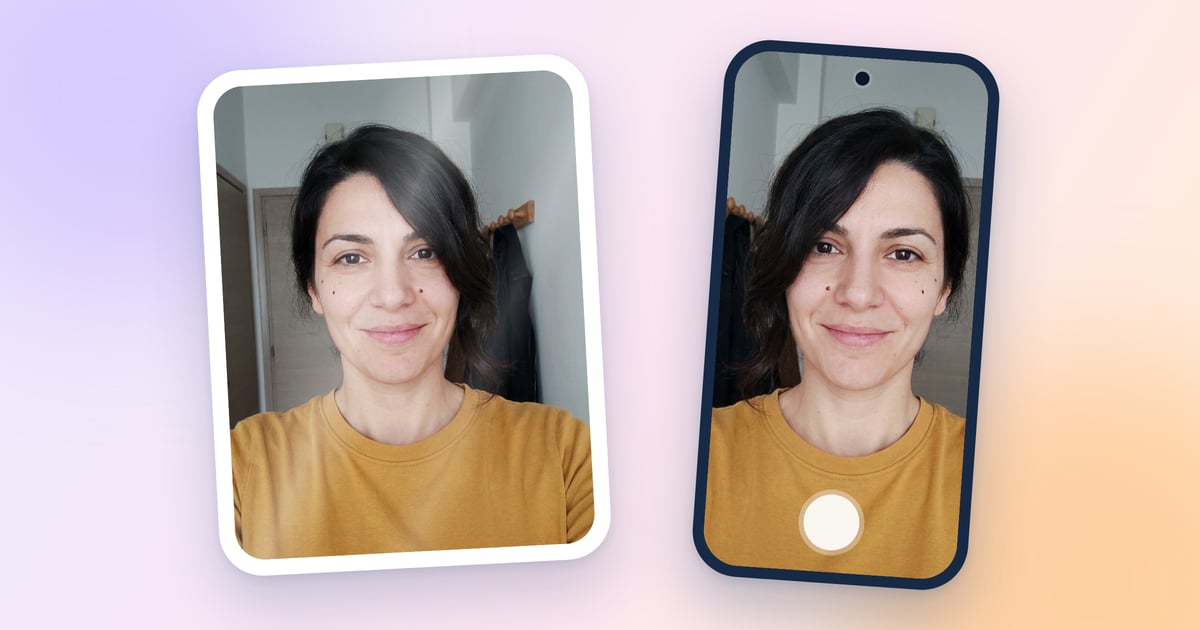
It is also the whole trick behind the “inverted” filter on TikTok. The filter flips the mirrored front-camera preview back to the way other people see you. If your face looks crooked in it, nothing has moved except the side everything is on. The people you know have been looking at this version for years.
2. A selfie is usually closer than the mirror
The second difference is distance, and it changes the shape of the face in the picture.
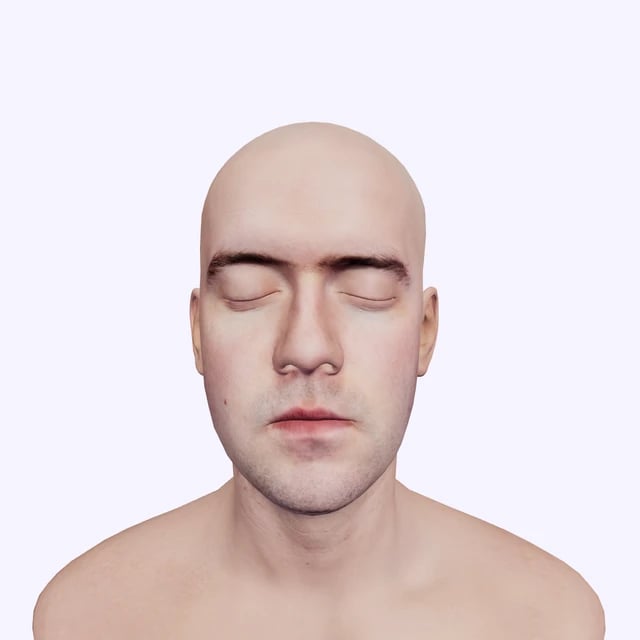
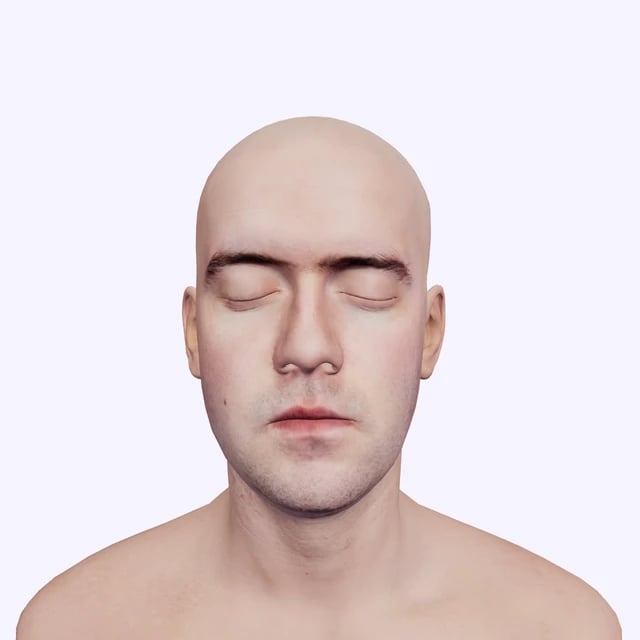
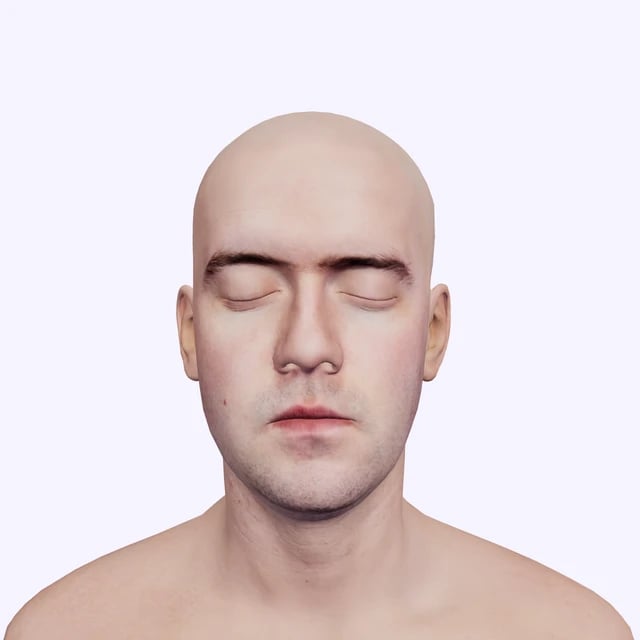
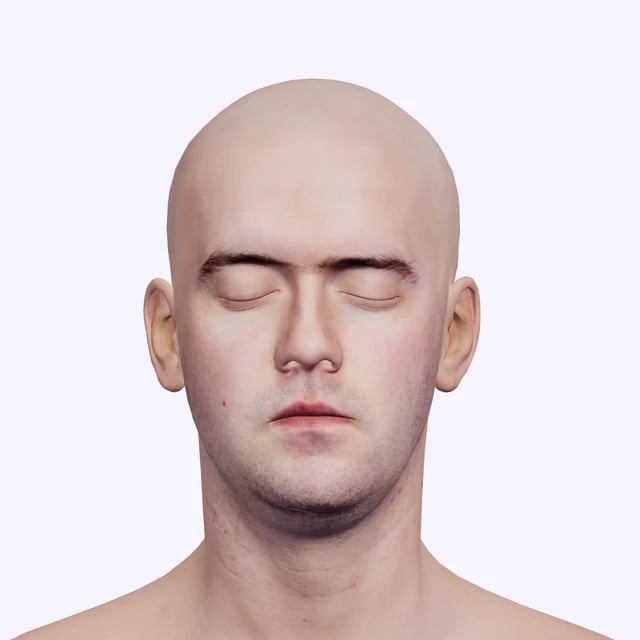
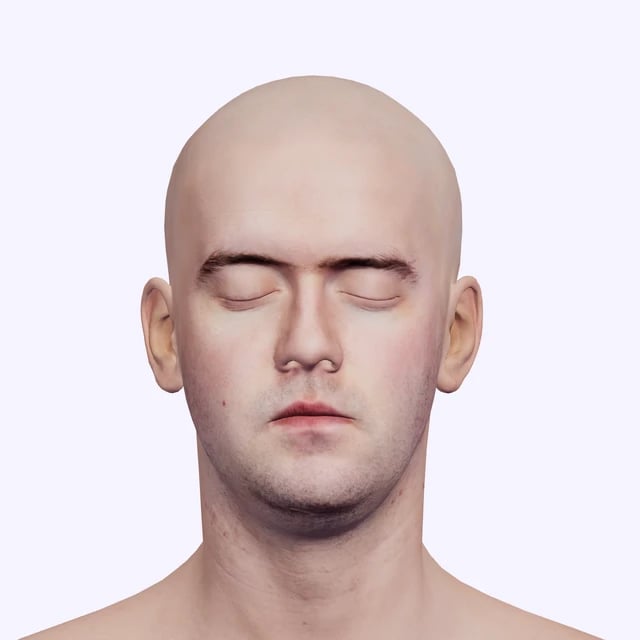
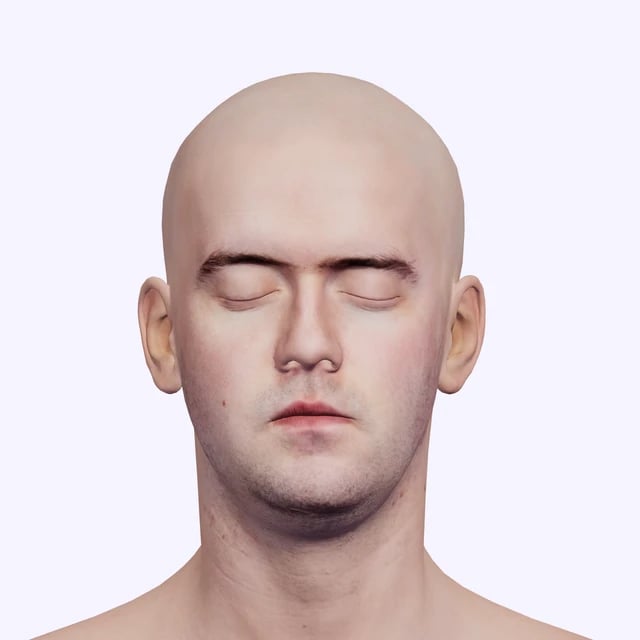
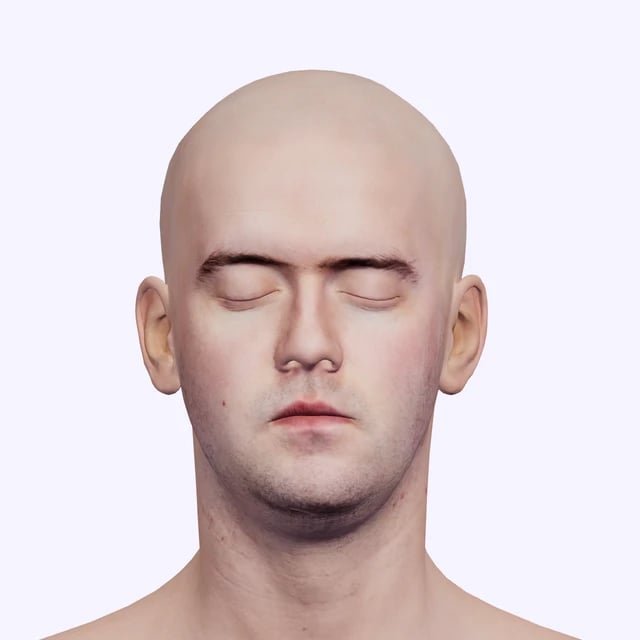
A camera draws things smaller the farther away they are. Twice as far, half as big. That holds inside a face too, because the tip of the nose is the closest point to the lens and the ears are the farthest. From across a room the gap between them barely matters. From arm’s length it is about a quarter of the distance to the nose, so the camera draws the nose noticeably bigger than the ears. Move the slider and watch the ears.
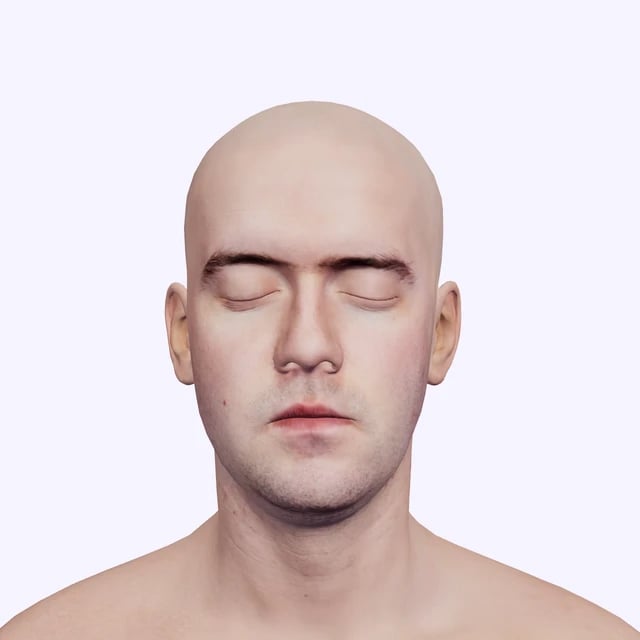
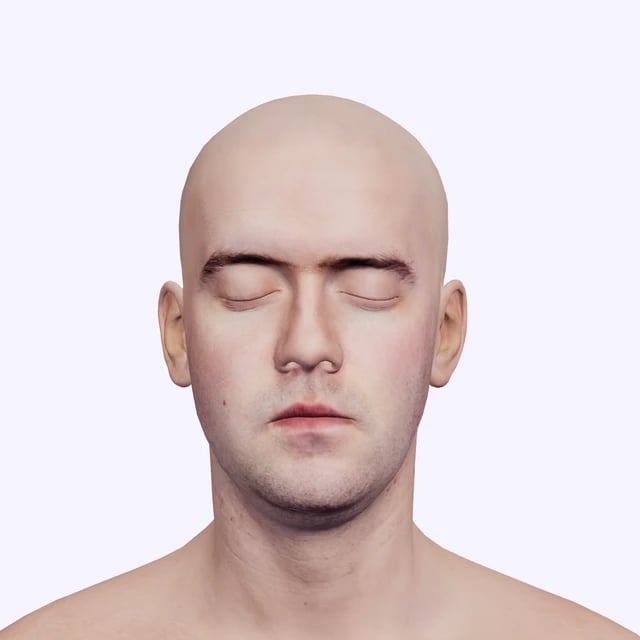
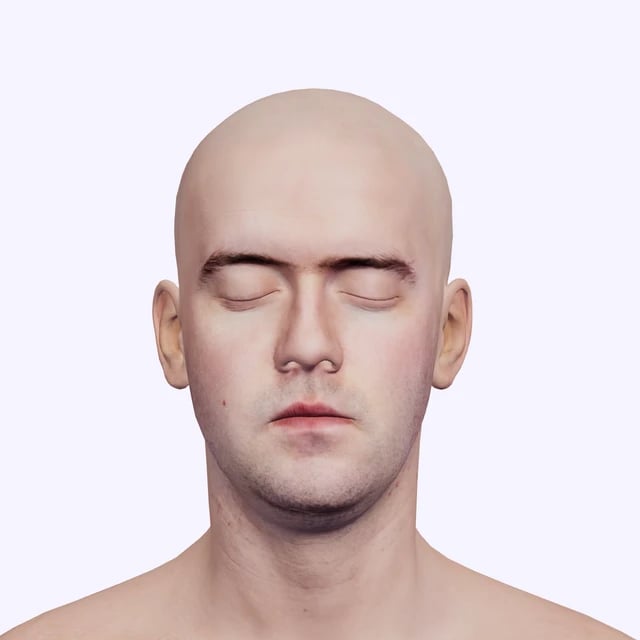
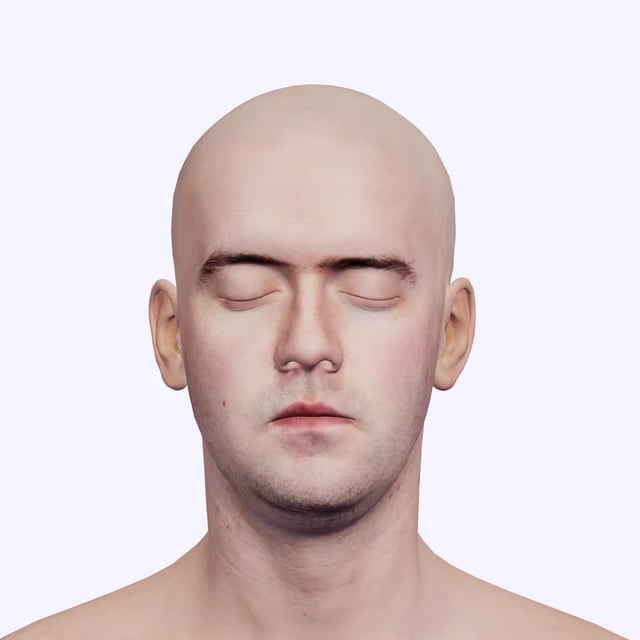
- Lens to nose
- 45 cm17.7 in
- Lens to ears
- 56 cm22 in
- Scale of the ears against the nose
- 80%
A 3D scan of a real head, scaled to a head height of 23 cm and photographed by a virtual pinhole camera from eleven distances. Every frame shows the same 31 cm square around the face, the way a photographer fills the frame from any distance. The man’s eyes are closed in the scan. Head scan by Lee Perry-Smith, CC BY 3.0.
The arithmetic behind the slider is short. On this scan the ears are about 11 cm behind the tip of the nose. Put the lens 30 cm from the nose and the ears are 41 cm away, so the camera draws them at 73% of the nose’s scale. Back up to 2 m and it is 200 against 211, and the ears are at 95%.
The lens appears nowhere in that sum. A longer lens does not change perspective. It lets the photographer stand two meters back and still fill the frame, and the distance does the work. That is why portrait guides recommend shooting with a longer lens from six to eight feet. Lenses and phone software change pictures in other ways too, but perspective depends on distance alone.
So where do a selfie and a mirror sit on that slider? Researchers who motion-tracked 58 people taking selfies found the phone a median 43 to 45 cm (17 to 18 inches) from the nose. The mirror is farther than it seems, because your reflection sits as far behind the glass as you stand in front of it. Stand 50 cm from the bathroom mirror and you are looking at your face from about a meter. The selfie is taken from less than half that.
Does a selfie make your nose 30% bigger?
You may have read that it does. The number is real, but it comes from a calculation and not from photos of people. For a 2018 paper from Rutgers, researchers built a geometric model of an average head. With the camera 12 inches (30 cm) away, the model’s nose is 30% wider for men and 29% for women than with the camera infinitely far away. The model measures that width against the face at the cheekbones, which it places half a head’s length, about 10 cm, behind the brow. So it is the slider’s arithmetic, applied to the brow and the cheekbones where the slider uses the nose tip and the ears.
When researchers measured photos of actual people, the numbers were smaller, and they measured other things. In 2022 a team in Dallas photographed 30 volunteers with a phone at 12 inches and with a studio camera at 5 feet (1.5 m). In the selfies the noses were 6.4% longer, and the width at the base of the nose did not change significantly. A 2024 study of 12 people found the middle of the face stretched vertically by 12% in phone photos from 12 inches, again compared with photos from 5 feet.
These changes sound small. They are enough to get in the way of recognizing someone. In a 2017 experiment, people looked at pairs of photos and said whether both showed the same person. When both photos were taken from the same distance, people who did not know the faces got same-person pairs right 97% of the time. When one photo was taken from 32 cm and the other from 2.7 m, they got 69%. People who knew the faces stayed close to 100%. The camera moved, and to a stranger the same person became somebody else almost a third of the time.
3. A photo is one instant
The third difference is time. In the mirror your face moves, and you are the one moving it. You settle your expression, tilt your head to the angle you like, and look. A photo takes one instant out of that movement, and many of those instants fall between expressions: a half blink, a mouth between two sounds, a sideways glance.
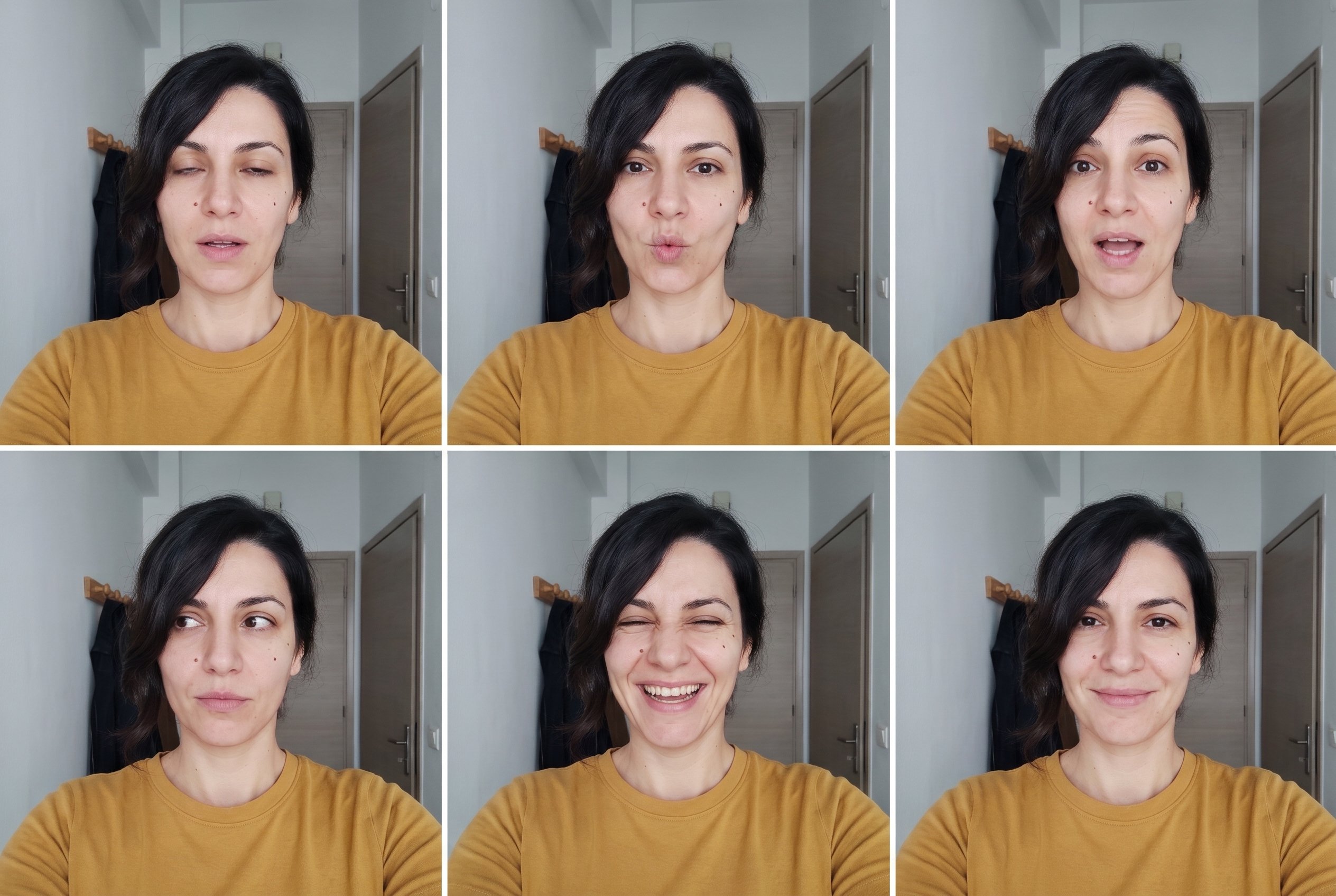
Six instants of one person talking. A camera can catch any of them.
Does an arbitrary instant really look worse than the face in motion? In 2012 psychologists tested it and named the result the frozen face effect. They took online videos of 20 people talking, cut 40 two-second clips, and split the clips into their 1,200 frames. Then raters scored the clips and the single frames for how flattering they were. In 91% of the comparisons that were not ties, the frame lost to the clip it came from. With a new group of raters, the same faces scored 4.6 out of 7 for attractiveness as video and 3.9 as stills.
Two things keep this from being the last word. The first experiment had only seven raters. And the frames were arbitrary moments of speech. When another team compared videos of 60 men with stills picked to look neutral and natural, the average ratings did not differ significantly. So an arbitrary frame tends to look worse than the moving face, and a well-chosen one need not. That is good news, because choosing is something you can do.
Even without motion, two photos of the same person can look like two people. In 2011 researchers collected 40 photos from the web, 20 each of two Dutch TV presenters, and asked British volunteers who knew neither of them to sort the photos into piles, one pile per person. The right answer was two piles. The median was 7.5, and the most common answer was nine. Dutch volunteers who knew the presenters mostly made two. Any single photo of you is one draw from a spread that wide.
4. You compare a photo with the face you remember
The last difference is not in the photo at all. To decide that a photo of you looks wrong, you have to compare it with something, and that something is your own idea of your face. There is evidence that the idea is slightly flattering.
In 2008 Nicholas Epley and Erin Whitchurch photographed students and made a row of versions of each photo. Some were morphed in 10% steps toward a composite of attractive faces, and others toward an unattractive face. Later each student saw the row and tried to find the real photo. On average they picked a version shifted toward the attractive end, by 6% in one experiment and by 12% and 13% in two others. They did much the same for a friend’s face, and showed no significant shift for a stranger’s.
If you have seen this study quoted, it was probably with the figure 20%. That was the single version that got the highest “this is me” rating in one experiment, not the average choice. We also found no registered replication of the experiment. The closest support is a 2019 study in which people chose among nine versions of their own face, made more or less attractive in steps, and again picked one slightly on the attractive side.
So an accurate photo may be losing to a slightly better-looking face in your head. That does not make every photo you dislike accurate. If you can point to what is wrong with a picture, these studies are no reason to talk yourself out of it.
Mirror or camera: which one is accurate?
Neither. The mirror shows your face moving, with left and right swapped. An unmirrored photo has left and right the way other people see them, and no movement. Each also shows the face from its own distance.
A more useful question is which view is closest to what another person sees. Take one ordinary case, someone sitting across a table from you. They see your face unmirrored, moving, from about a meter. The table checks the common views of your face against those three things. The face you remember is left out, because it belongs to you and not to any of the views.
| View | Left and right | Seen from | Motion |
|---|---|---|---|
| The mirror | Left and rightMirrored | Seen fromTwice your distance to the glass | MotionMoving |
| A selfie on the screen, before the shutter | Left and rightMirrored | Seen fromArm’s length, about 45 cm | MotionMoving |
| The saved selfie | Left and rightSet in the camera app | Seen fromArm’s length, about 45 cm | MotionOne frame |
| A photo someone else took | Left and rightAs others see it | Seen fromWherever they stood | MotionOne frame |
| Your own tile on a video call | Left and rightMirrored unless switched off | Seen fromWherever the webcam is | MotionMoving |
| What the others on the call see | Left and rightAs others see it | Seen fromWherever the webcam is | MotionMoving |
| A video someone else took of you | Left and rightAs others see it | Seen fromWherever they stood | MotionMoving |
| You, to a person across a table | Left and rightAs others see it | Seen fromAbout a meter, and changing | MotionMoving |
Green marks the cells that match what the person across the table sees.
No row is your true face. The last row is just an everyday view of it. A video that someone else shoots from about a meter matches it in all three columns. The mirror, from half a meter, differs only in left and right. A saved selfie differs in distance and in being a single frame, and in left and right too if your phone saves it mirrored. The selfie preview on your screen differs in left and right and in distance.
Two rows depend on a setting, and it is worth knowing how yours is set. An iPhone mirrors the front-camera preview and then saves the photo the other way round, unless Mirror Front Camera is switched on in the camera settings. Pixel phones call the same switch “Save selfie as previewed,” and Galaxy phones “Save selfies as previewed.” So if a selfie seems to flip the moment you take it, it did. The screen showed you the mirror version and the gallery kept the other one.
Video calls do the same thing with an ordinary webcam. Zoom’s “Mirror my video” setting changes only your own view. The Teams desktop app mirrors your own video unless you turn that off, and the setting does not change what other people get. Meet mirrors your self-view and shows everyone else your video unmirrored.
What to change when you take a photo
You cannot change the face you remember, but the other three differences are in your hands. This is for the times you need a photo. Once you have a few you would use, stop.
- Back up. Distance is the easiest one to fix. Prop the phone a meter and a half away or hand it to someone, use the rear camera, and crop afterwards. Cropping is safe, because a cropped photo keeps the proportions of the distance it was taken from. The setup is in our phone headshot guide.
- Take twenty or so frames in one sitting, then stop. One frame is one instant, and the frozen face effect says an arbitrary instant tends to score below the moving face. Twenty frames give you something to choose from. The number is ours, not a study’s.
- Know which way your phone saves. If it saves selfies as previewed, every selfie you send is the mirror version. It is the one you are used to, but people who know you see it the unusual way round, and any lettering behind you comes out reversed.
Who should pick your photo?
There is a second body of research that never mentions mirrors. It asked a simple question: who picks better photos of a person, the person or a stranger?
In the first study, from the University of New South Wales, students ranked their own Facebook photos by how much each one looked like them. Strangers who had seen the student only briefly ranked the same photos. Then a third group tried to match the top-ranked photos to the person. They did better with the strangers’ picks than with the students’ own, and better again when several strangers’ rankings were averaged.
The second was about impressions rather than likeness. In it, 102 students each gave twelve photos and rated how likely they were to use each one on a social profile, a dating profile and a professional one. A stranger did the same for them. Several hundred online raters then scored the chosen photos. The strangers’ choices made the better first impression. The raters found them more trustworthy and more competent. On attractiveness the difference was not significant.
A third study, from Toronto, found a related gap. Frequent selfie-takers rated their own selfie above a photo an experimenter took of them. Outside raters did not.
Why would a stranger choose better? The studies do not say, and they did not test the four differences. Those are one plausible reason. You judge your own photo against a face that is mirrored, moving, seen from another distance and remembered as slightly better-looking, and a stranger has none of that in the way. What the studies do show is narrower. When strangers are the ones who will judge a photo, someone else’s pick did better than the owner’s.
Here is how we would use that. It goes beyond what was measured.
- Decide what the photo is for. Being recognized and making a first impression are different jobs. In the second study people chose different photos for different kinds of profile.
- Shortlist the ones you are willing to use. You keep the veto.
- Ask two or three people. In the first study people agreed poorly on which photo was the best likeness, so one opinion is not enough. For likeness, ask people who have seen you. For a first impression, ask people who do not know you, because they are closer to the audience.
- Ask about the job. “Which of these looks most like me?” or “Which of these makes you want to work with me?” gets a more useful answer than “Which is best?”
What the chosen photo has to do at thumbnail size is in our LinkedIn profile picture guide.
Where AI headshots come in
We make AI headshots from selfies, so all of this applies to our own product. When a customer says “it doesn’t look like me,” there are two possible causes, and they need telling apart.
The first is everything above. A headshot is a single frame. In the seven selfie-and-headshot pairs we checked for this post, none came out flipped. Seven pairs are not a guarantee, but where it holds, a headshot made from unmirrored selfies shows your face the way round you are less used to.
The second cause is the model. A generated photo can go wrong in a way no mirror or camera can. The image model can change the face. It can make a jaw squarer, a nose straighter or a face several years younger, and what comes out is a flattering photo of somebody else. We call that likeness drift, and it is a defect in the image.
Both can be in the same picture, and you cannot always tell them apart. A second opinion helps with the first. Someone who knows you can say whether they see you in the photo, though their yes does not rule out drift. To look for drift, compare the headshot with more than one photo of yourself, and allow for what distance, angle and light do to a jaw or a nose. Camera distance does not move a mole or take ten years off a face.
And you do not need to prove anything to reject a headshot. If it does not look like you to you, that is reason enough not to use it.

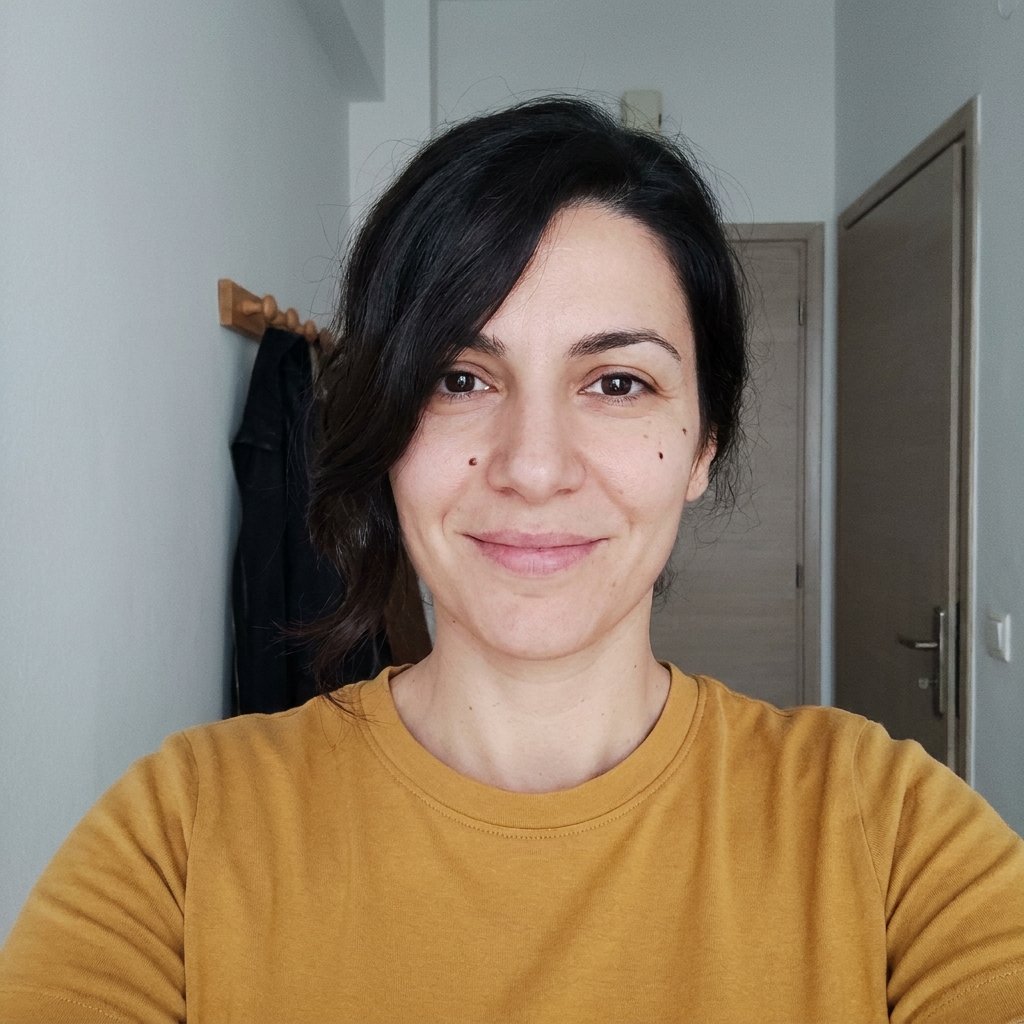
A selfie and a headshot Close Enough generated from it. In this pair the clothes, the light and the background are new, the hair falls on the same side, and the moles are on the same sides of the face.
Here is what we do about it on our side. On paid orders our upload check warns when a face is wider than 55% of the photo’s shorter side, or taller than 80% of it, with the message “Your face is too close to the camera.” It measures framing rather than distance, and you can overrule it. An order returns 24 headshots, so there is room to reject some. And we refund an order when three things hold: the results do not look like you, none of the 24 is usable, and the selfies followed the guidelines. Email us within 14 days of purchase.
What this post cannot tell you
- How much each difference matters. None of the studies here separates the four. Each looked at one of them, on different people, with a different task.
- Whether the psychology holds for everyone. The geometry is true of any camera. The findings on preference, memory and photo choice come mostly from a few dozen students each. The 1977 study photographed only women, and for several of the findings we found no independent replication.
- Your own proportions. The slider uses one scanned head, scaled to a head height of 23 cm. Yours is a different head.
- The size of one result. For the first New South Wales study we could read only the published abstract, which gives the direction of the effect and no figure. Our description of its procedure comes from the university’s summary.
- Where we stand. We sell headshots, and “get a second opinion on whether it looks like you” is a convenient conclusion for a company whose customers sometimes say it does not.
Three things “this photo doesn’t look right” can mean
So when a photo of you looks wrong, it is one of three things.
It may be an unfamiliar view of your face: unmirrored, from another distance, caught at an arbitrary instant. That is the four differences at work, and it is mostly you who notices.
The image may have changed your face. A generated photo can do that and a camera cannot. That is a fault in the image, and you can reject it without proving anything.
Or the photo may be accurate and still be the wrong one for its job. That is the case where, in two studies, someone else’s choice did better than the owner’s. Ask someone.
FAQ
Is the mirror or the camera more accurate?
Neither. A mirror swaps left and right and shows your face from twice your distance to the glass. A camera keeps left and right the way other people see them, unless it saves selfies mirrored, and shows the face from wherever the camera was. An unmirrored photo taken from about a meter is close to what a person across a table sees.
Do other people see me inverted?
Yes, in the sense that they see the orientation the “inverted” filter shows, and they always have. The filter adds no asymmetry. It shows your face in the orientation you are not used to. In a 2021 experiment, 30 people looked into an ordinary mirror and into one that does not reverse, and 73% called their face in the second one less symmetric. It was the same face.
Why does my face look lopsided in pictures?
Every face is slightly asymmetric. In the 3D study of 100 healthy volunteers, the average mismatch between a face and its mirror image was 0.8 mm, measured as a root mean square. An average cannot say how much yours differs. A photo shows the same asymmetry a mirror does, on the other side. If your face looks uneven only in photos or in the inverted filter, the unfamiliar orientation is one explanation.
Which camera shows how others see me, front or back?
The back camera, and the front camera when its photos are not saved mirrored. Distance matters too. The back camera is often farther away, because someone else is holding the phone.
If I look bad in pictures, do I look bad in real life?
A bad photo does not show that. A photo is one instant from one distance in one light, and in one experiment raters scored arbitrary stills below the same face in motion. The studies here rated photos and clips of other people, and none of them can say how any one person looks. People around you see a moving face.
Why do I look bad in photos other people take?
Photos taken by someone else are usually unmirrored, so they show the orientation you are least used to. Someone else picks the moment, and nobody sets the light or the angle for you. Light from above deepens the shadows under the eyes, and a camera below eye level shows more of the chin. Distance is often in their favor. From a couple of meters the proportions are those of a portrait.
Why does my nose look big in selfies?
Because the phone is close. On the head scan above, a camera 30 cm away draws the ears at 73% of the scale of the nose tip, so the nose looks large next to them. From 2 m the ears are at 95%. Hold the phone farther away, or use the rear camera from a distance and crop.
Why do I look different on Zoom and other video calls?
Your own tile is usually mirrored, the webcam is often closer than a person would sit, and a laptop camera looks up from below eye level. The other people on the call get the same distance and angle, unmirrored.
Can someone be attractive but not photogenic?
Yes. An unflattering still does not settle how a face looks in motion. Raters scored arbitrary frames below the clip they came from. In a study of videos of 60 men, the ratings of stills chosen to look neutral did not differ significantly from the videos’.
How can I see what I look like to other people?
A short video of you talking, filmed by someone else from about a meter away and near eye level, comes close. It shows one viewpoint on one day.