
- Guides
- Explainer
We Tested 30 Free AI Headshot Generators With One Selfie. Four Worked.
One synthetic selfie, default settings, and a log of everything each tool asked for before showing an image. Four of 30 returned a headshot of the right person with no account and no email; one of the four is ours. The other 26 stopped at an email field, a login, a six-photo upload, a queue, an ethnicity pick-list, or handed back a picture of someone else.
Search “free AI headshot generator” and the first two pages of results say free in the title. We wanted to know what free costs in practice: an email, an account, more photos, a wait, a watermark, a lower resolution, or a face that is not yours.
So we uploaded one selfie of one person to every tool that offered a free run, on one afternoon, and wrote down every screen.
The short version
- Four of 30 returned a headshot of the person in the selfie with no account and no email: Magic Hour, VisualGPT, Pixelbin, and our own Close Enough. Three more returned an image we could download, but it was a stranger (Supawork, twice) or the original selfie with a new background (Magic Studio, AiProPortrait). On 17 we stopped at a wall we would not pass. The other six had no free run to attempt.
- 14 of the 30 wanted an account before showing anything. 11 of them say “free” or “no sign-up” in the headline. Two wanted only an email address. Aragon wanted an email, an account, and six photos. Three put the free user in a queue: a 14-minute clock that never ticked, a waitlist that “may be paused”, and a page that says 60–90 days.
- Two tools change the photo count after you start. “Upload one selfie” becomes “Upload 3 photos”. “Upload your photo” becomes “at least 6 of your best photos” plus your email.
- “Unlimited” appears on two pages. One of them says “2 free image daily” in the tool itself.
- Five tools rank for “free” and have no free tier. One of the five is an app-store trial that turns into a weekly subscription. A sixth URL is a listicle, not a tool.
- Giving away one headshot costs a vendor $0.003 to $0.04 in compute. The walls are not there to save compute. A free generator is an acquisition channel, and each wall is the price the vendor put on the visit: nothing, an email or an account, or a page that was never going to deliver.
- Our own free generator is one of the 30. We tested it the same way and scored it the same way as the other 29.
How we tested
The sample. The tools in the first two pages of web-search results for “free AI headshot generator” on 15 September 2026, plus every tool named in the ten “best free AI headshot generator” articles that rank for it, minus duplicates. That is 29. Our own free generator makes 30.
The input. One selfie of a person who does not exist: a synthetic persona from our landing-page examples, curly hair, freckles, a phone photo in a living room. A synthetic face means the same file can go to 30 companies without anyone’s permission, and every tool gets the same input at the same resolution.
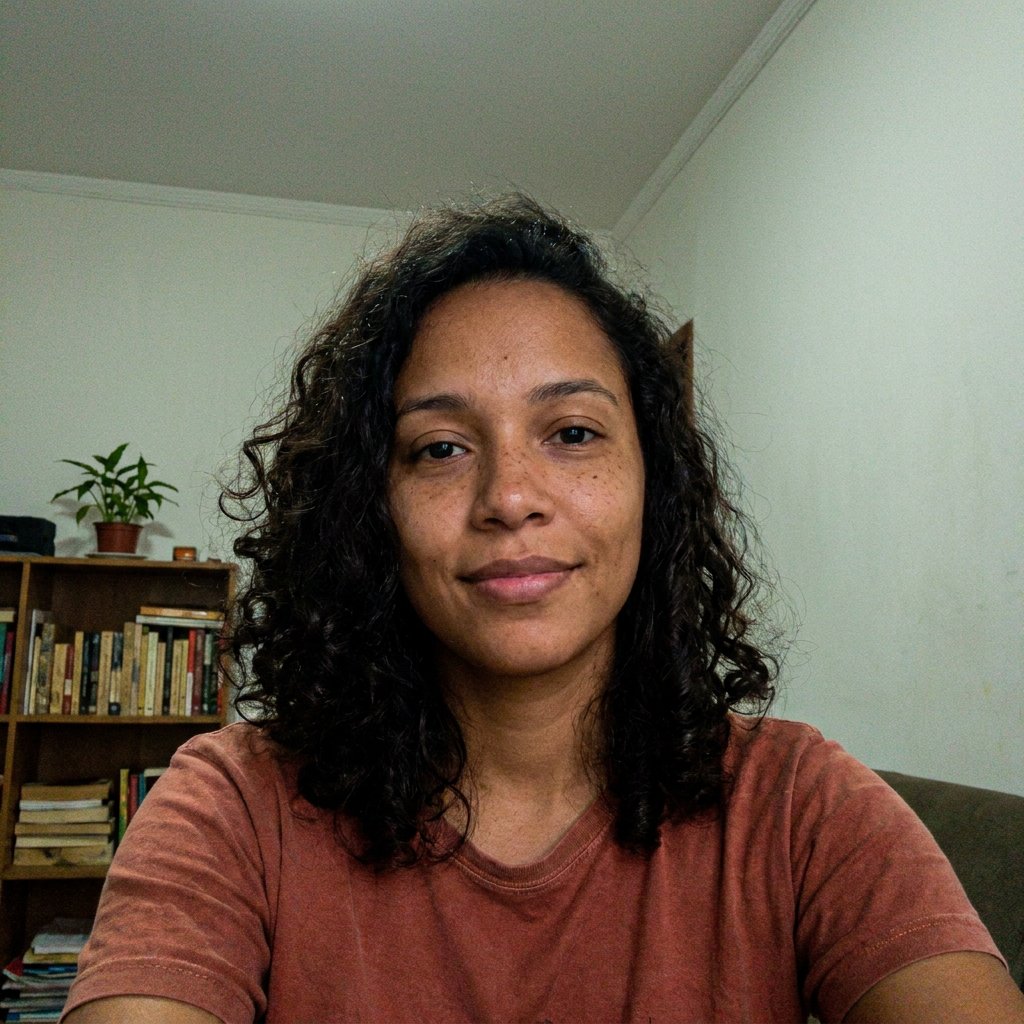
The one input. A synthetic person, one phone selfie, sent to all 30 tools as-is.
The rules, fixed before the first upload:
- Defaults everywhere. First suggested style, first backdrop, no prompt engineering. One run per tool. A second run only where the first produced no image or an obviously mis-answered one: Supawork (our script answered its questionnaire wrong the first time), Pixelbin, YouCam.
- Log every ask. We captured each screen between the landing page and the first image and recorded what it wanted: account, email, card, more photos, a questionnaire, a queue, an app install.
- Stop at the first wall we would not pass. No accounts, no emails, no cards, no app installs. Where a tool wanted three, five, or six photos, it got the same selfie that many times. This is the only way to compare 30 tools without handing 29 other companies an inbox.
- Watch the timers. Where a tool showed a wait, we waited, and reloaded.
- Record the output. Size, watermark, and whether the face matched the person in the selfie. We judged likeness by eye; we did not measure it.
The setup. The runs were automated: Chromium driven by Playwright at 1440×900, from a European IP, in a fresh profile for every tool. Some sites treat automated browsers differently from people, so where a run looked blocked rather than walled we repeated it by hand in a normal browser the same day. That covered three tools. Pixelbin had shown the script an hCaptcha; by hand there was no CAPTCHA and it returned a headshot in about 40 seconds. YouCam had returned a 404 after the upload; by hand it reached its credit-pack picker and a sign-up wall. HeadshotPro’s queue timer had not moved for 35 minutes; by hand it did not move either. The ledger shows the hand-run result for all three. Our own tool was also run by hand, on the production page, with a second take of the same synthetic selfie from the same session. Runs happened between 14:00 and 15:30 UTC.
Version 1.0, 15 September 2026. We did not send these findings to the companies before publishing. Every row is a public page as an ordinary visitor saw it that afternoon. If a vendor thinks a row is wrong, write to support@closeenough.ai. We will re-run that funnel and amend the row with a dated note. The raw ledger with every number in this post is available on request.
The ledger
30 of 30 tools
One selfie, 15 September 2026. Open a row to see what the tool asked for and what it returned.
The page saysCreate 3 professional headshots per day from one photo – free, no sign up or watermark. LinkedIn-ready.
What came back1024 × 1024 PNG, no watermark, same personWaitAbout 7 secondsWhat stopped usNothing – it delivered without asking for anythingFirst price we sawCreator plan from €10.75 a month, on the pricing pageAs advertised. Upload, Generate, a headshot with the curls and freckles intact, a counter saying “2 images left today”. The sign-up pitch (“Skip the wait”, “Higher resolution outputs”) sits beside the result, not in front of it.

The selfie
What came back
Open Magic Hour in a new tabScreens

The page saysAI Headshot Generator – Free Online, No Sign-up & No Ads.
What came back1024 × 1024, no watermark, same personWaitAbout 45 secondsWhat stopped usNothing – it delivered without asking for anythingFirst price we saw“Upgrade Now · 90% OFF” banner; no price on the tool pageUpload, pick a style, Generate. The same face in a full suit and tie in a boardroom. A “Log in for free” button and a 90%-off banner sit in the sidebar. Saving the result to a project needs the login; downloading does not.

The selfie
What came back
Open VisualGPT in a new tabScreens

The page saysFree AI Headshot Generator. Generate a free professional headshot from a selfie. No sign-up, no credit card, no watermark.
What came back1024 × 1024 JPEG, no watermark, same personWaitAbout 12 secondsWhat stopped usNothing – it delivered without asking for anythingFirst price we saw$6.99 for 24 headshots, shown after the free resultOurs. One selfie in, one headshot from the small model, no account, no email, no watermark, first free background and outfit. The run was by hand on the production page, with a second take of the same synthetic selfie; the method section says why. Curls, freckles and skin tone kept; skin softened like the other two.

The selfie
What came back
Open Close EnoughScreens

The page saysUp to three headshots each month… preview & download the headshot for free, without watermarks or any hidden costs.
What came back1024 × 1024 PNG, no watermark, same personWaitAbout 40 secondsWhat stopped usNothing – it delivered without asking for anythingFirst price we saw“Click to Claim Discount – 30% off”; 4096-pixel download is paid; no base price shownUpload, pick Corporate, Generate. The automated run got an hCaptcha and stopped there. A hand run in a normal browser got no CAPTCHA and returned a 1024-pixel headshot with the curls and freckles intact in about 40 seconds. The download menu offers the 1024-pixel file free and the 4096-pixel file behind a crown icon.

The selfie
What came back
Open Pixelbin in a new tabScreens


The page saysFree AI Professional Headshot Generator – Studio Quality in Seconds. Add 1 selfie for the best results.
What came back600 × 800 PNG, no watermark, different personWaitAbout 36 secondsWhat stopped usDelivered an image of someone elseFirst price we saw“Pricing · 30% OFF” in the headerAfter the selfie, ten questions: gender, style, age, hair colour, hair length, hair type, body type, glasses, ethnicity, model. Then an image you can download without an account. Two runs, two different people, neither of them the person in the selfie.

The selfie
What came back
Screens


The page saysFree AI Headshot Generator: Lightning fast, 100% free, no signups!
What came back512 × 512, the selfie on a new background, cut-out edges visibleWaitAbout 3 secondsWhat stopped usA background swap sold as a generatorFirst price we sawNot on the page; InstaHeadshots reviews cite $59–$74instaheadshots.com redirects here. Upload, three seconds, 53 thumbnails of the same selfie cut out and pasted onto new backgrounds. A “PAID” card beside the grid promises “hyper-realistic headshots” on the paid plans.

The selfie
What came back
Screens

The page saysFree AI Headshot Generator: No Sign-Up, No Watermark.
What came back1200 × 1200, the selfie with the background removedWaitUnder a minute, in the browserWhat stopped usNothing – it delivered without asking for anythingFirst price we saw$19 for 40+ headshots, stated beside the toolThe tool removes the background from your photo and lets you recolour it, in the browser. The page says so (“FREE TOOL” next to “PAID AI HEADSHOT PATH”) and downloads the file without asking for anything. Not a generator, and it does not pretend to be one.

The selfie
What came back
Screens

The page says1 free HD headshot · No sign-up · No credit card. Upload one selfie.
What stopped usA queue that an account or a payment skipsFirst price we saw$29 “first-view offer” to unlock the previews; $39 on the pricing pageOne selfie became “Upload 3 photos”, then gender, then a review screen, then a queue: “Create a free account to skip the line”, a 14-minute ring timer marked Paused. It said 14 for the 21 minutes we watched and after a reload. At 35 minutes it said “Looks like it’s busy. Refresh this page in a bit.” Repeated by hand in a normal browser: the timer did not move there either. We did not create the account, so we cannot say whether that moves the queue.
Screens


The page saysGenerate FREE* professional headshots for LinkedIn, resumes, and team profiles in about 30 minutes. Upload your photo.
What stopped usA queue that an account or a payment skipsFirst price we saw$35 Basic packOne photo in, a modal out: “upload at least 6 of your best photos”, a required email (“We’ll send your AI photoshoot to this address”), and an account. The asterisk resolves in the footer: free headshots go through a waitlist “which may be paused or delayed depending on demand”. Reviews put the wait at 12 to 15 days.
Screens

The page saysFree AI Headshot Generator For 4K LinkedIn Photos. Upload your selfies and get 10 professional 4K headshots… free, with a full commercial licence.
What stopped usAccount or sign-in before any imageFirst price we saw$35 Basic packThe upload area is a Log in / Sign up box (Google or an email code). The page text puts free users in a 60–90-day queue and paid users at under an hour. Free results may be used in BetterPic’s marketing, per its own terms.
Screens

The page saysFree AI Headshot Generator. Upload a selfie and get back a gallery of studio-grade headshots.
What stopped usEmail address before any imageFirst price we saw$49–59 per person, per third-party listings; the site links no pricing pageUpload, an optional prompt, then a required email (“We’ll send your AI photoshoot to this address”) and a terms checkbox. Submitting without an address gets a red toast: “Please enter your email address.” The page elsewhere says free spots “fill fast, often within a minute or two”.
Screens

The page says100% Free AI Professional Headshot Generator. While it may not match the photorealistic quality of our premium AI service, it is completely free.
What stopped usEmail address before any imageFirst price we saw“View premium plans” – no number on the free pageEmail required (“We will send your free headshot to this email”), plus gender and an outfit. Lower on the same page, a table states the free tier: 1 photo, 720px, watermark yes, personal use only, one background.
Screens

The page says2 free headshots · No account needed. Preview quality, lower resolution.
What stopped usAccount or sign-in before any imageFirst price we saw$9.99 for 10 headshots at 1024 pixelsThe uploader works. The tool under that title says “Sign in to start generating headshots” and the button reads “Sign In to Generate”. Several styles carry a padlock: “requires credit pack”.
Screens

The page saysFree Professional Headshot Generator. Unlimited! $0.
What stopped usAccount or sign-in before any imageFirst price we sawInterview-copilot subscription; no headshot priceFive photos into the uploader, a preview step, then Generate opens a sign-up form. The header runs a “Lock in 50% off forever – limited time only” countdown. Its code counts to the visitor’s local midnight and restarts every day, so there is no end date. The product is an interview copilot; the headshot page collects sign-ups for it.
Screens


The page saysFree AI Headshot Generator – Fast, Unlimited, No Sign-Up.
What stopped usAccount or sign-in before any imageFirst price we saw“Save 30%” on the pricing linkA promo modal on arrival. The tool text says “2 free image daily, then 6 premium credits / image”. With a photo uploaded and a style picked, the Generate button stays disabled until you sign in.
Screens


The page saysAI Headshot Generator. Generate (5 credits).
What stopped usAccount or sign-in before any imageFirst price we saw30 credits for $4.99Upload, then a Generate button labelled with a credit cost, then a Login / Sign-up modal. The credits come with the account.
Screens

The page saysAI Headshot Generator. Start for Free.
What stopped usAccount or sign-in before any imageFirst price we saw“First Subscription up to 50% OFF”The upload sends you to a second page; Generate there opens a Wondershare login. A side panel offers “Daily Free Credits – 3 free credits every day”. The published free plan, which we did not reach: 720p with a watermark, and a $0.00 three-day premium trial that auto-renews.
Screens

The page saysAI Headshot Generator. Get stunning AI headshots for your LinkedIn, resume, acting & modeling portfolios.
What stopped usAccount or sign-in before any imageFirst price we sawCredit packs from $26.99Gender, then “select 3 to 10 styles”, then “Upload one best photo”, then Generate, then “Continue to Generate AI Headshots” with Google, Facebook, Apple, or email. Its plan page says Free exports are watermarked; we did not reach one.
Screens

The page saysAI Headshot Generator: Get professional headshots online free.
What stopped usAccount or sign-in before any imageFirst price we sawCredit packs; no number on the tool pagePick a template, press “Generate (8 Credits)”, get “Please log in first. First time sign in to get 30 free Credits.” Thirty credits at eight per run is three runs.
Screens

The page saysGenerate AI Headshot for Free with AI Ease.
What stopped usAccount or sign-in before any imageFirst price we sawNot shown before the loginA consent dialog, two promo modals for video models, a style grid with some styles marked Pro. “Try it” on a free style opens “Sign Up or Log in to Get Started”.
Screens

The page saysAI Professional Headshot Generator – 100% Free. Create Your AI Professional Photo in 30s.
What stopped usAccount or sign-in before any imageFirst price we saw$9.99 for 250 creditsChoose a model, choose a style, upload, “Generate Now”, then “Sign in to HeadshotMaster” with an email and password form. The 100% Free banner is on a sister site’s header.
Screens

The page saysFree AI Headshot Generator: Create AI Headshots.
What stopped usAccount or sign-in before any imageFirst price we sawCanva Pro, $144 a yearThe feature page links into the Canva editor, which needs an account. Canva’s own copy: two free credits, then wait 24 hours. AI training on user content is on by default for Free and Pro accounts.
Screens

The page saysAI Headshot Generator Online. Quickly turn selfies into high-quality, professional headshots for LinkedIn, resumes, CVs, social media and more!
What stopped usAccount or sign-in before any imageFirst price we sawCredits: 20 pictures for 30 credits; app subscriptions $5.99–$9.99 a month in the listingThe automated upload got a 404 twice. By hand: “Create Headshots Now”, upload, then “Choose your Pack”: 20 pictures for 30 credits, 40 for 40, 80 for 60. Generate opens “Log in or sign up now to receive free credits, no credit card required”. How many credits a new account gets is not on the page, and the page never says “free”.
Screens


The page saysFree AI Professional Headshot Generator.
What stopped usAccount or sign-in before any imageFirst price we sawFirefly Standard, $9.99 a monthThe button leads to firefly.adobe.com and a Sign in prompt. Free daily generations come with an Adobe ID; the page does not say how many.
Screens

The page saysAI Headshot Generator. Turn selfies into professional headshots.
What stopped usRanks for “free”, offers nothing freeFirst price we saw$2.99 StarterRanks for the “free” query. The page has no free tier: the cheapest pack is $2.99 for four photos with a 40-minute to two-hour wait. Landing page only; no upload attempted.
Screens

The page saysWorld’s Most Advanced AI Headshots. 50% Off – Today Only.
What stopped usRanks for “free”, offers nothing freeFirst price we saw“Starting from $17”Ranks for “free”; offers nothing free. The page opens with a countdown discount modal and links no pricing page. Landing page only; no upload attempted.
Screens

The page saysOwn your first impression with the best AI headshot generator.
What stopped usRanks for “free”, offers nothing freeFirst price we sawNot shown before checkoutNo free tier, and no price on the site. Third-party reviews say you reach the checkout before you see a number and put it around $49. Landing page only; no upload attempted.
Screens

The page saysFire your photographer.
What stopped usRanks for “free”, offers nothing freeFirst price we saw$19 a month, StarterSubscription only. The Starter plan is labelled, on the pricing page, “Low quality photos” and “Low likeness”. The terms take a perpetual, sublicensable licence over uploads. Landing page only; no upload attempted.
Screens

The page saysAI photo and video enhancer, in one click.
What stopped usRanks for “free”, offers nothing freeFirst price we saw$4.99–$9.99 a week, per third-party listingsHeadshots are app-only: install, upload 8–12 photos, start a free trial that becomes a weekly subscription. Trustpilot rates it 1.4 of 5 with 84% one-star reviews, many about charges after cancelling. Not run: no app installs in this protocol.
Screens

The page saysAI headshot generator (the URL). 9 Best Free AI Headshot Generators (the page).
What stopped usRanks for the query, is an articleFirst price we saw$2 a credit for the video toolsThe address that ranks is a listicle, not a tool. The “30 Free Credits Every Day” banner on it is for the company’s video product.
Screens

Legend
- Same person
- The person in the selfie, by our eye
- Different person
- A generated stranger
- Background swap
- The original photo on a new background
- We stopped
- A wall we would not pass
- What the tool demanded before any image
- A limit on the free image: a watermark, or a low-res file (720 pixels or smaller)
Every screen is from 15 September 2026.
Three caveats. We scored one afternoon; a page can look different tomorrow. The “no free tier” rows did nothing wrong except rank for a word that does not describe them. And an account wall is a legitimate price. What the ledger records is whether the page states that price before you upload.
What this audit cannot tell you
- One face is not a bias test. Every result here comes from one synthetic, light-brown-skinned woman. Nothing in this post measures how these tools treat darker skin, older faces, or glasses. That needs a face set across the Fitzpatrick scale, and it is a different piece.
- One afternoon, one IP, one browser. These funnels are A/B tested and vary by country. The wall you meet may differ from the wall we met.
- We never passed a wall. We cannot say whether what is behind BetterPic’s login or Aragon’s waitlist is any good. The ledger scores the path to the first image, not the image behind a door we did not open.
- Automation is visible to some sites. Three runs that looked blocked were repeated by hand (Pixelbin, YouCam, HeadshotPro; see the setup note above). Two of them changed; the ledger shows the hand-run result. The other 26 automated runs were not repeated by hand.
- We judged likeness by eye. “Same person” and “Different person” are our calls. The images are in the post so you can make your own.
- Our own row was run by hand, on the production page, with a second take of the same synthetic selfie, chosen by us, and scored by the same eye as the other rows.
- Four things we could not verify: whether HeadshotPro’s frozen timer or Aragon’s waitlist reflects real demand (both are disclosed on the page; we have no evidence either way); Remini’s weekly prices (third-party listings); the free-tier watermarks at Media.io and Fotor (published plans, not a run); and Secta’s price (third-party reviews).
The walls
Every tool that did not simply deliver stopped us in one of five places: a queue, an email field, a login, a questionnaire, or the terms. This section walks through them in that order, with a screenshot of the wall where it helps.
Under each screenshot there is also a pattern name from the FTC’s 2022 dark-patterns report and Harry Brignull’s deceptive.design taxonomy:
- Forced action. You must do something unrelated to get what was offered.
- Hidden information. The condition is on the page, but not where you are looking.
- False urgency. A clock that pressures instead of informing.
- Misleading claim. The headline says one thing and the tool says another.
None of this is specific to headshots. An ICPEN sweep of 642 subscription sites in 2024 found at least one such pattern on 76% of them.
The queue

HeadshotPro. The queue screen after the upload: a 14-minute clock that never moved, and an email field to skip it.
Dark pattern:Forced action
HeadshotPro’s landing page says “1 free HD headshot · No sign-up · No credit card” and asks for one selfie. After the selfie it asks for three photos, then your gender, then shows a review screen, then this: “Almost there! Your headshots are queued. We’re experiencing high demand right now. Create a free account to skip the line…” Next to the text, a ring timer says 14 minutes left, with a small orange badge that says Paused.
We watched it for 21 minutes. It said 14 the whole time. We reloaded; it said 14. At 35 minutes the number was gone and the ring said “Looks like it’s busy. ☹️ Refresh this page in a bit.” We refreshed; same text. Over 35 minutes the number never moved. We then repeated the run by hand in a normal browser, and it did not move there either. The only thing on the screen that offers to move it is the email field that creates the account.

Aragon AI. After one photo: at least six photos and a required email.
Dark pattern:Forced action · Hidden information
Aragon puts the same mechanism in a footnote. The page says “Generate FREE* professional headshots”. The asterisk resolves to a waitlist “which may be paused or delayed depending on demand”, with paid plans as the way around it. BetterPic skips the timer and states the free queue at 60–90 days, next to “under an hour” for paid customers.
Why queues? A place in the line costs the vendor nothing to sell. The same GPU renders the image in 30 seconds whether it runs now or in 12 days. Priority processing has no cost of goods, which is why software companies sell it.
The email field
Two tools asked for nothing except an address. Dreamwave’s page has an upload box, a prompt, and a required email field labelled “We’ll send your AI photoshoot to this address”. Submit without one and a red toast says “Please enter your email address.” Dr. Headshot’s “100% Free AI Professional Headshot Generator” has the email field above the outfit picker and, further down, a table that states the free tier: 1 photo, 720px, watermark yes, personal use only. A third tool, Aragon, asks for an email on the way to an account and six photos, under the same sentence about sending the photoshoot to your address.
An address costs the visitor nothing and is the only thing a non-buyer leaves behind. An address that later buys is worth a pack, $29 at HeadshotPro. We never entered one, so we cannot say what these companies do with it. One Trustpilot reviewer, below, calls HeadshotPro, which puts the field behind the queue, an “Email gatherer!”. Three more funnels here are built around the same field.
The account, before or after the upload
14 of 30 tools wanted an account before showing anything. What differs is when they ask.

BetterPic. The upload box is a login box.
Dark pattern:Forced action
BetterPic and Canva ask first: the upload control is behind the login. Adobe Firefly sends you to sign in before the tool loads, and Aragon asks for the account together with the email and the six photos.

Fotor. The modal on Generate, after styles and upload.
Dark pattern:Forced action
HeadshotGen, Fotor, Remaker, AI Ease, HeadshotMaster, Cutout.pro, Media.io, YouCam, and LockedIn AI ask last: you pick styles, upload, pick a backdrop, and the wall appears on Generate. HeadshotGen’s title says “2 free headshots · No account needed”; its button says “Sign In to Generate”. Remaker’s modal says “Please log in first. First time sign in to get 30 free Credits”, and the button you just pressed said “Generate (8 Credits)”, so 30 credits is three runs. YouCam prices the smallest pack at 30 credits, then offers “free credits” for signing up without saying how many.
Asking last works better for the vendor. By the time the modal appears you have chosen a style, uploaded a face, and spent two minutes. A checkout that asks for the shipping address before showing the total works the same way.

NoteGPT. “Unlimited” in the title, “2 free image daily” in the tool, Generate disabled until sign-in.
Dark pattern:Misleading claim
Two of the account-last tools have a headline the tool contradicts. NoteGPT’s title is “Free AI Headshot Generator – Fast, Unlimited, No Sign-Up”. Its tool says “2 free image daily” and greys out Generate until you sign in.

LockedIn AI. A “50% off forever” countdown above “Free Professional Headshot Generator”.
Dark pattern:False urgency
LockedIn AI says “Unlimited!” and “$0”, runs a “50% off forever – limited time only” countdown in the header, and puts a sign-up modal after Generate. We read the page code behind the clock. It has no end date: every second it recomputes the time left until the visitor’s next local midnight. A reader in Tokyo and a reader in Toronto see different clocks, and each one restarts from 24 hours at midnight, every day. The offer never ends. The company sells an interview copilot. The headshot page collects sign-ups for it.
The questionnaire
Supawork was one of the seven tools that gave us an image without an account. It also asked ten questions between the selfie and the image:
- What’s your gender? Male, Female, Kid.
- Select your style. Studio, Outdoor, LinkedIn, Realtor, Lawyer, ERAS…
- How old are you? Age bands.
- What’s your hair color? Auburn, Black, Blonde, Brown, Gray, Red, White, Other.
- What’s your hair length?
- What’s your hair type?
- What’s your body type? The selfie shows one.
- Do you wear glasses? The selfie shows that too.
- What’s your ethnicity? A required pick-list.
- Which AI model? Standard, Advanced.
- The selfie
Input
Sent as-is, both runs
- Different person
Supawork, run 2
600 × 800, ≈ 36 s, no watermark
Run 2, every answer matched to the selfie.
 Different person
Supawork, run 1
600 × 800, ≈ 36 s, no watermark
Run 1, every answer left on the first option.
We ran it twice. On the first run our script picked the first option on every step, including “Male”, and got back a smiling auburn-haired man in a white shirt. Our fault, in part. So we ran it again with every answer matched to the selfie. It returned a woman with straight blonde-brown hair, fair skin, no freckles, and no resemblance to the input. Two runs, two answer sets, two strangers. Nothing we could see in either output came from the selfie.
Pay with your face
The last wall is in the terms. BetterPic’s free tier grants the company “permission to use the results in our own marketing”. Photo AI’s terms take a “perpetual, worldwide, non-exclusive, sublicensable… irrevocable copyright license” over the images you upload, and say fees are non-refundable. Canva’s AI training setting is on by default for Free and Pro accounts. FastShot, a free tool from an earlier wave, said in its policy that “images of free users are public, while the renders of users who buy a subscription are private”.
Some vendors say the opposite. Magic Hour states one-day retention and no training on uploads. Aragon’s privacy policy says it contractually prohibits its AI providers from training on face data. Remini says uploads are not used for training unless you opt in. You cannot tell the two groups apart from the free page, because the free page does not say.
What people say
Trustpilot is a biased sample. Angry people write reviews; satisfied people mostly do not. What follows is anecdote, not a measurement: a few reviews we picked because they describe the same funnel we walked through. Here is the Aragon free funnel, described by three reviewers, 16 months apart. Public reviews on trustpilot.com, captured 15 September 2026.

Aragon AI, March 2025. A 12-day, 50-minute wait for the free option.

Aragon AI, August 2025. Photos and email first, the waitlist after.

Aragon AI, July 2026. 15 days, or refer a friend who pays.
Aragon’s replies confirm the mechanism: “due to high demand, there’s currently a waitlist”.
The second set is about the word free: HeadshotPro, then Magic Studio, formerly InstaHeadshots.

HeadshotPro, April 2025. “It is advertised as 100% free.” The reply: “we’re definitely not free!”

HeadshotPro, July 2026. “Email gatherer!”

Magic Studio (InstaHeadshots), March 2026. A $74 paywall after the last step.

Magic Studio (InstaHeadshots), December 2025. “Watermarked to death and then $59 to pay.”
One more review, from January 2026, says the model cannot render brown skin, “Asians, to be more precise”. We did not test skin tone. Our one selfie is one person; see the limitations above.
There is research on the models underneath these tools. A 2024 study of Stable Diffusion XL found its generated faces varied 18.9% to 56% less in skin tone than real photo sets. A February 2026 paper found that Gemini’s and OpenAI’s image models returned a light skin tone on more than 96% of prompts that did not specify one. Both studies generated faces from text alone, with no reference photo. A headshot tool has your selfie as a reference, which those studies did not, so they do not settle the question.
Why the wall is where it is
A free headshot generator is an acquisition channel. The page ranks for “free”, the visitor uploads a selfie, and the vendor decides what that visit has to turn into.
It is not about the cost of the image. We argued in an earlier post that the expensive step, training a small model on each customer’s photos, is gone: current models hold a likeness from one or a few reference photos in a single pass, and the four tools that returned the same person, ours included, did it from one selfie in 7 to 45 seconds. One free headshot is one model call. At September 2026 list prices that is $0.003 on FLUX schnell, a small open model, at fal.ai or Replicate, and $0.039 on Nano Banana, Google’s Gemini 2.5 Flash Image, at API list price. Pixelbin’s model picker shows that name; HeadshotPro’s asset paths do too. List price leaves out failed runs, retries, moderation, storage, and bandwidth, so the real number is higher. It is still cents.
So the wall is the price the vendor puts on the visit, and the ledger shows three prices:
- Nothing. Magic Hour, VisualGPT, Pixelbin, and our own tool render the image and bet that some of the people who like it come back for the paid pack. The free result is the pitch. The limit is a quota: three a day, three a month, one a day.
- An email or an account. Fourteen tools took the visitor’s details before showing anything, and two took only an email. The image is not the product here; the address is. It opens a sales channel that outlives the visit.
- The bait. A queue that never moves, “Unlimited” over a two-a-day limit, a countdown to nothing, and six pages that rank for “free” with no free run on them. The free image was never going to arrive. The page exists to catch the search and route it to checkout.
Two things follow. Since the image is nearly free, the free tier is never about the cost of the image. It is about what the image is allowed to do: be low-res, be watermarked, be delayed, arrive by email, or be good enough to convert. Every wall in the ledger is a choice about that.
The same channel runs upstream of the tools. Of the ten pages that ranked for “free AI headshot generator” when we looked, four were vendor blogs and four carried affiliate links.
The results
Seven tools produced an image without an account or an email. Here they all are, next to the input, at the same size.
- The selfie
Input
One synthetic person, one phone selfie
Sent to every tool as-is.
- Same person
Magic Hour
1024 × 1024, ≈ 7 s, no watermark
No account. Curls and freckles kept. 3 a day.
- Same person
VisualGPT
1024 × 1024, ≈ 45 s, no watermark
No account. Full-length by default; sign in to save.
- Same person
Close Enough (this site)
1024 × 1024, ≈ 12 s, no watermark
One a day. Run by hand with a second take of the same selfie.
- Same person
Pixelbin
1024 × 1024, ≈ 40 s, no watermark
Run by hand. Three a month; the 4096-pixel version is paid.
- Different person
Supawork, run 2
600 × 800, ≈ 36 s, no watermark
Questionnaire answered to match the selfie. Different woman.
- Different person
Supawork, run 1
600 × 800, ≈ 36 s, no watermark
Questionnaire left on defaults. The selfie was ignored entirely.
- Background swap
Magic Studio
512 × 512, “in 3 seconds”
The selfie, cut out and pasted on a train station. Not generated.
- Background swap
AiProPortrait
1200 × 1200, instant, in-browser
Background removed and recoloured. The page says so itself.
The other 23 tools returned nothing: 17 stopped at a wall we would not pass, 6 offered no free run.
Magic Hour, VisualGPT, Pixelbin, and our own generator returned the person in the selfie, by our eye: curls, freckles, skin tone, the shape of the face. The blazer and the office are invented; that is what the tool is for. All four softened the skin. VisualGPT added a full suit and tie by default, which is a style choice rather than a likeness problem.
This matches how the models work. The tools that kept the face did it from one selfie, in seconds, with no per-person training. That is what current image models do, and it is why we think an AI headshot should cost about ten dollars. What separates a free tier from a paid one is the size of the model and the number of reference photos, not a different kind of pipeline. Smaller models keep the broad features and soften the fine ones, which is why the freckles survive and the skin texture does not.
Some vendors say this on their own pages:
- Dr. Headshot: “it may not match the photorealistic quality of our premium AI service”.
- Aragon: the free generator “won’t have the same studio-quality photorealism as our Professional AI Headshot Generator”.
Fair enough, when it is written down.
Our own tool
We tested our generator the same way as the other 29; its row is in the ledger above. Here it is, so you can run it on your own selfie and judge the result yourself.
Our free generator
The same tool as on its own page, running live. What you are agreeing to, before you drop a photo:
- One headshot per day, one selfie in
- Our small model, not the one in the paid pack
- No account, no email, no card
- Up to 1K, no watermark, yours to use anywhere
- Selfie and result deleted after 30 days, never used for training
- Afterwards we show you the $6.99 pack. That is how this pays for itself
FAQ
Which free AI headshot generators work with no sign-up?
In this audit, four: Magic Hour (three a day, about seven seconds, 1024 pixels, no watermark), VisualGPT (about 45 seconds, 1024 pixels, sign in only if you want to save), Pixelbin (three a month, about 40 seconds, 1024 pixels, no watermark; the 4096-pixel version is paid), and our own Close Enough (one a day, about 12 seconds, 1024 pixels, no watermark). All four kept the face. Supawork also delivers without an account, but not the same person.
Do free tools watermark the result?
Some. Dr. Headshot states a watermark and 720 pixels for the free tier. Media.io and Fotor list watermarked exports on their free plans. HeadshotGen calls its free output a lower-resolution preview. Magic Hour, VisualGPT, Pixelbin, Supawork, and our tool do not watermark.
Can a free AI headshot be used on LinkedIn?
If it looks like you, yes. LinkedIn’s policy asks that the photo be your likeness, not that a camera took it. If it is a stranger in a suit, no, and not because of the policy.
Did the tools know they were being tested?
We never contacted a vendor and entered nothing anywhere. The runs were automated, which some sites detect. The setup note and the limitations above say which rows that could affect.